
If your Maytag washer suddenly shows the F9 E1 code, you might feel confused or worried. This error can appear during a cycle or just before it finishes. Many users panic, thinking their machine is broken. But the truth is, the F9 E1 code is a specific signal about a drainage problem, and it’s possible to fix it yourself if you know what to look for. This guide will help you understand exactly what the code means, why it happens, and how to address it. You’ll find practical advice, step-by-step solutions, and comparisons that make the technical parts easy to grasp—even if English isn’t your first language.
What Does The Maytag Washer Code F9 E1 Mean?
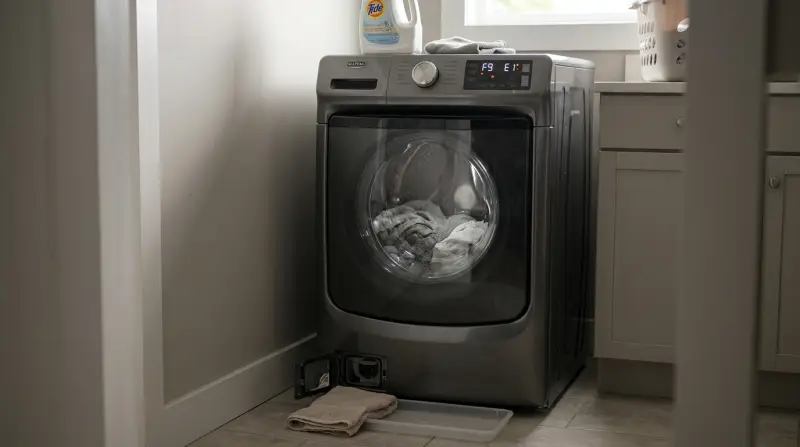
The F9 E1 error on Maytag washers is not random. It tells you there’s a drainage issue. More specifically, your washer is taking too long to drain water, or it can’t drain at all. Maytag sets a timer for each wash cycle. If water doesn’t leave the drum fast enough, the washer stops and shows the F9 E1 code.
For most models, the washer expects to drain within 8 minutes. If it doesn’t, you’ll see the error. This can happen in any cycle—wash, rinse, or spin. The code is not dangerous, but it does prevent your washer from working until you solve the problem.
It’s important to know that this code is the washer’s way of protecting itself. If the machine kept trying to run with too much water inside, it could overflow or damage internal parts. So, the F9 E1 error is actually a helpful warning that points you straight to the drainage system.
Why Does The F9 E1 Error Happen?
There are several reasons your Maytag washer might show the F9 E1 code. Understanding these causes can help you find the best fix. Here are the most common ones:
- Clogged drain pump or filter
- Blocked drain hose
- Kinked or bent drain hose
- Faulty drain pump
- Too much detergent (especially high-sudsing)
- Improper installation
- Problems with the washer’s control board
- Low water pressure
- Foreign objects stuck in the washer
Each issue affects drainage differently. Sometimes, more than one problem exists at the same time. For example, a clogged filter and too much detergent can both slow water flow and confuse the washer’s sensors. That’s why it’s important to check each potential cause carefully, not just the most obvious one.
9 Items That Cause The F9 E1 Error
To fully understand the F9 E1 code, you need to look at all nine possible causes. Let’s go through each one in detail.
Clogged Drain Pump Or Filter
The drain pump moves water out of the washer. If it’s clogged, water cannot flow out fast enough. The pump often has a filter to catch lint, coins, or small objects. When the filter gets full, drainage slows down.
Signs of this problem include:
- Washer not draining at all
- Slow draining
- Unusual noises during draining
Over time, even small bits of lint and threads from clothing can build up and form a thick layer in the filter. If you wash items like rugs or pet bedding, debris can collect even faster. Sometimes, you might even find buttons, screws, or small toys caught in the filter.
To fix:
- Unplug the washer
- Locate the drain filter (usually at the bottom front)
- Open the filter cover
- Remove and clean the filter
- Check inside the pump for any debris
If water spills out when you open the filter, don’t panic—that’s normal. Use a shallow tray or towel to catch drips. This job is simple for most users. But if the pump itself is blocked or damaged, you may need a technician.
Blocked Drain Hose
The drain hose carries water from the washer to your home’s plumbing. It can become blocked by lint, detergent build-up, or foreign objects.
Common symptoms:
- Water remains in the drum after a cycle
- Washer tries to drain but fails
A blocked hose can happen slowly over time. You might notice water draining more slowly each week. Sometimes, buildup happens after washing muddy clothes or heavy loads. In rare cases, rodents or insects can also block the hose, especially in basements or garages.
How to fix:
- Disconnect the hose from the washer and wall
- Run water through the hose (outside or in a sink)
- Use a flexible brush to clear any blockage
- Reconnect securely
Always check both ends of the hose. Sometimes the blockage is near the wall, not the washer. If you find the hose is brittle or has cracks, replace it to avoid leaks.
Kinked Or Bent Drain Hose
Even if your hose is clear, it might be bent or kinked. This restricts water flow and triggers the F9 E1 error.
Signs to look for:
- Hose looks twisted or flattened
- Washer drains slowly, but there’s no blockage
A common cause is pushing the washer back against the wall too far. Even a small bend can slow drainage. Sometimes, hoses are too long and loop in a way that creates kinks.
Fixing this is easy:
- Straighten the hose
- Make sure there’s enough space behind the washer
- Avoid pushing the washer too close to the wall
If your laundry area is small, consider using a shorter hose or a special anti-kink hose. A simple adjustment can solve this problem. Many beginners miss this, thinking only about clogs.
Faulty Drain Pump
If the pump motor fails, water can’t leave the washer. Pumps can burn out after years of use or due to electrical issues.
How to check:
- Listen for pump noise during draining. If silent, the pump might be dead.
- Remove and inspect the pump for damage.
Sometimes, the pump makes a buzzing or humming sound but doesn’t move water. That can mean the impeller (the part that spins) is jammed or broken. If you’re comfortable with tools, you can remove the pump to check for blockages or broken parts.
Replacement pumps cost $40–$80 on average. Some Maytag models make pump access simple, but others require removing panels. If you aren’t sure, it’s wise to call a professional—especially if your washer is still under warranty.
| Issue | DIY Difficulty | Cost Estimate |
|---|---|---|
| Clogged pump/filter | Easy | $0 (DIY) |
| Blocked hose | Moderate | $0–$10 (DIY) |
| Faulty pump | Hard | $40–$80 (parts) |
Too Much Detergent
Using too much detergent—especially high-sudsing types—creates extra foam. This foam can block water flow, confuse sensors, and slow draining.
Symptoms:
- Lots of bubbles in the drum
- Washer stops and shows F9 E1 even when nothing is blocked
Many people think more soap means cleaner clothes. But modern washers use less water, so excess soap turns to foam. This foam can fill the pump and hose, preventing water from draining out.
Fixes:
- Run a rinse cycle to clear suds
- Use HE (High Efficiency) detergent if your washer is HE-rated
- Follow dosage instructions carefully
If you accidentally use regular detergent in an HE washer, you may need to run two or three rinse cycles to clear all the foam. Many users ignore detergent guidelines. This is a hidden cause that’s easy to fix and prevent.
Improper Installation
If the drain hose is installed incorrectly, water might flow back into the washer or drain too slowly.
Common mistakes:
- Hose inserted too far into the standpipe
- Hose not elevated properly (should be 36–48 inches above ground)
- Hose not secured
If the hose is too low or not secured, dirty water can siphon back into the washer. This creates odd smells and drainage errors. Make sure the hose forms a “U” shape at the drain, as recommended in your manual.
Correct installation prevents siphoning and overflow. Always check the user manual for your model. If you moved the washer recently, double-check installation.
Problems With The Washer’s Control Board
The control board is the brain of the washer. If it malfunctions, it can misread signals, causing errors like F9 E1 even when drainage is normal.
How to spot this:
- Washer shows F9 E1 even after fixing physical issues
- Other error codes appear randomly
Control board issues are rare but can happen after power surges, lightning, or water leaks inside the washer. If you notice strange noises or lights, or the washer behaves unpredictably, suspect the board.
You may need a technician to diagnose and repair the board. Control board replacement costs $150–$300. If your washer is still under warranty, contact Maytag support before doing anything else.
Low Water Pressure
Low water pressure can confuse sensors. If your home’s water supply is weak, the washer may not drain as expected.
Causes:
- Plumbing issues in the home
- Shared water lines with other appliances
Some washers check water flow rates. If the incoming water or draining speed is too low, the machine might “think” there’s a blockage. This is more common in homes with old pipes or during times of high water use (like mornings or evenings).
Solutions:
- Check water pressure at the tap
- Avoid running other appliances during wash cycles
If you suspect this, try running your washer at a different time or after fixing plumbing issues. This issue is often overlooked. If you have frequent F9 E1 codes and all washer parts seem fine, check your home’s water supply.
Foreign Objects Stuck In The Washer
Small items like socks, coins, or hairpins can get stuck in the drum or pump. These objects block water flow and trigger the error.
How to find them:
- Remove the drum and check inside
- Inspect the pump and hose
This often happens with baby socks, small underwear, or jewelry. If you hear rattling or scraping during draining, a foreign object may be stuck. Prevent this by emptying pockets and using mesh bags for small items.
| Cause | Frequency | DIY Fix? |
|---|---|---|
| Clogged filter | Common | Yes |
| Foreign object | Less common | Yes |
| Faulty control board | Rare | No |
How To Fix The F9 E1 Error Step-by-step
If you see the F9 E1 code, follow these steps:
- Unplug the washer for safety.
- Check the drain hose for kinks and blockages.
- Inspect and clean the drain filter.
- Look for foreign objects in the drum and pump.
- Check detergent use—run a rinse if you see too much foam.
- Test the pump—listen for noise and check for damage.
- Review installation—make sure hose height and placement are correct.
- Check water pressure if other fixes fail.
- Reset the washer after fixing the issue.
If the error remains, call a professional.
Take photos before you disconnect anything, so you remember where each part goes. If you’re unsure about any step, check your user manual or look for video tutorials online. Sometimes, a small missed step—like not tightening the hose clamp—can cause leaks or new errors.
Example: Real-world Fix
Maria, a Maytag owner, saw the F9 E1 code after every wash. She tried cleaning the filter and hose, but the error stayed. After checking her detergent, she found she was using double the recommended amount. Switching to HE detergent and using less solved the problem.
Another example: John noticed the washer draining slowly after moving it to a new apartment. He discovered the drain hose was kinked behind the machine. Straightening the hose and giving it more space fixed the issue instantly.
Comparing Maytag Washer Drainage Issues
Different drainage issues need different fixes. Here’s how they compare:
| Symptom | Likely Cause | Fix |
|---|---|---|
| Washer won’t drain | Blocked hose/pump | Clear blockages |
| Slow draining | Kinked hose, clogged filter | Straighten hose, clean filter |
| Error code but no blockage | Detergent or control board | Reduce detergent, check board |
| Error after installation | Improper hose setup | Reinstall hose |
Even if two washers show the same error code, the solution can be completely different. That’s why it’s important to match the symptom to the likely cause before you start repairs.
Preventing F9 E1 Errors
You can prevent most F9 E1 errors with simple habits:
- Clean the filter monthly
- Check the drain hose for kinks after moving the washer
- Use the correct detergent and dosage
- Empty pockets before washing
- Install the washer as recommended
Many people skip regular cleaning because their washer “seems fine. ” But filters slowly collect debris, and hoses can kink without warning. Setting a calendar reminder for simple checks can save you from bigger problems.
These steps save time and money. Many people only react after an error happens. Prevention is easier and cheaper.
Common Mistakes When Fixing F9 E1
Beginners often make these errors:
- Ignoring the filter—many forget to clean it, thinking only the hose matters.
- Using too much detergent—extra suds can block drainage even if hardware is fine.
- Not checking hose installation—hose height and placement are critical.
- Trying to fix the control board themselves—this can lead to more damage.
- Forgetting to unplug the washer—safety first, always.
Some users also rush through the repair, forgetting to secure hoses or clean up spilled water, which can cause new leaks. Take your time, follow each step, and double-check your work before running a test cycle.
Avoid these mistakes for a smoother repair process.
When To Call A Professional
If you’ve tried all the fixes and the F9 E1 code keeps appearing, it’s time to call a technician. Especially if:
- The pump or control board needs replacement
- You find electrical issues
- The washer is still under warranty
Professional help costs more, but it’s safer for complex repairs. Also, if your washer is leaking water, making burning smells, or tripping your circuit breaker, stop using it and call for help right away.

Maytag Washer Models And F9 E1 Code
Not all Maytag washers are the same. Some newer models have extra sensors and smarter control boards. Older models may have simpler error reporting.
For example:
- Maytag MVWC565FW: Commonly shows F9 E1 with clogged filter
- Maytag MHW5630HW: Sensitive to detergent issues
- Maytag MVWB765FW: Hose installation problems are frequent
Always check your model’s manual for specific error code details. The steps to clean the filter or access the pump can be different for each model. If you have a smart washer, check if it can provide detailed error logs through an app.
Data And Statistics On Washer Drainage Issues
According to a 2023 survey, drainage problems are the second most common washer issue in the US, after door lock failures. 34% of Maytag owners reported at least one drainage error in the first three years of use. Of those, 72% fixed the problem themselves. Only 28% needed professional help.
The survey also found that regular cleaning and correct detergent use reduced error rates by half. Households with pets or young children (who wash smaller items and bedding) had more frequent drainage clogs.
This shows most F9 E1 errors are simple to solve. The key is knowing what to check and how to fix it.

Non-obvious Insights For Beginners
Many users focus only on the hose and pump. But two hidden issues are:
- Detergent type and quantity: Even “correct” detergents can cause errors if used in excess.
- Installation height: If the hose is too low or inserted too deeply, water can flow back, causing slow drainage.
Another tip: after moving your washer, always check the hose for kinks. Moves and vibrations easily bend hoses and cause errors.
Also, don’t ignore small objects. A single lost sock or coin can block the pump and cause repeated errors. Using mesh bags for socks and checking pockets before washing prevents many drainage problems.
Practical Tips For Long-term Washer Care
To keep your washer running smoothly:
- Run an empty rinse cycle monthly to clear suds and debris
- Inspect hoses for wear and replace every 5 years
- Clean the drum and filter after every 20 washes
- Use mesh bags for small items
- Update firmware if your model supports it (some smart washers allow this)
- Leave the washer door open between loads to prevent mold and musty smells
These habits reduce error codes and extend the life of your machine. If you notice unusual sounds or smells, don’t wait—investigate right away.
Maytag Washer Code F9 E1 Vs Other Error Codes
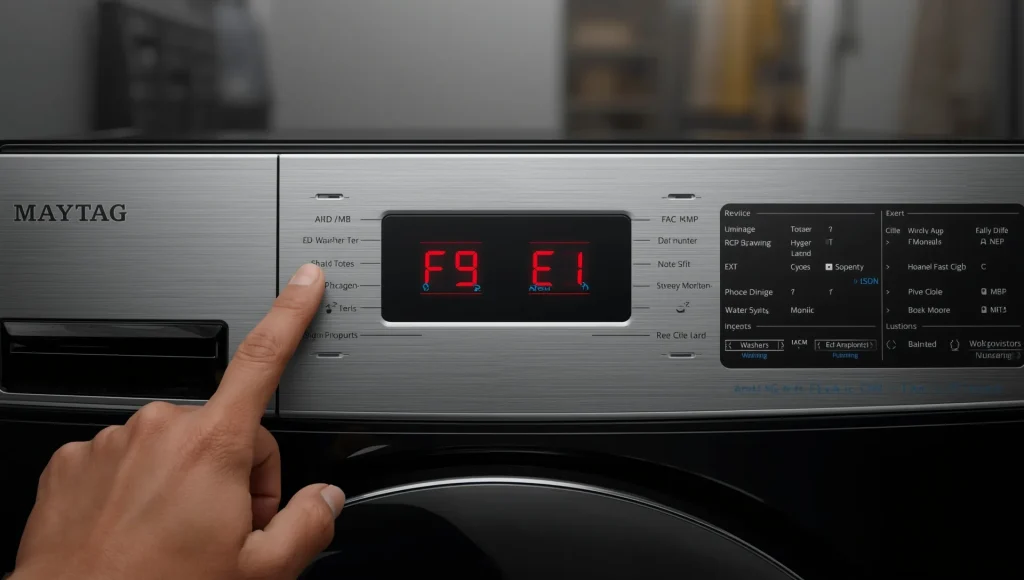
Maytag washers show several error codes. The F9 E1 code is drainage-specific. Others include:
- F5 E2: Door lock issue
- F8 E1: Low water pressure
- F3 E2: Temperature sensor problem
Each code means something different. Never confuse F9 E1 with other codes. Fixes are unique for each error.
If you need more details about error codes, visit the official Maytag support page: Maytag Error Codes.
Frequently Asked Questions
What Is The F9 E1 Code On My Maytag Washer?
The F9 E1 code means your washer has a drainage problem. It’s taking too long to drain water, usually because of a blocked hose, clogged filter, or pump issue. The washer stops the cycle to prevent damage.
How Do I Reset The F9 E1 Error?
After fixing the cause (like cleaning the filter or hose), unplug your washer for 1 minute, then plug it back in. Start a new cycle. If the error appears again, check for other issues.
Can I Fix The F9 E1 Error Myself?
Yes, most F9 E1 errors can be fixed at home. Clean the drain filter, check the hose, and use correct detergent. If the pump or control board is faulty, call a technician.
Does The F9 E1 Code Mean My Washer Is Broken?
No, it’s just an alert about drainage. Your washer isn’t broken, but it needs attention. Fixing the issue usually restores normal function.
How Can I Prevent The F9 E1 Code In The Future?
Clean the filter monthly, check hoses for kinks, use proper detergent, and install your washer as recommended. These habits prevent most drainage problems.
Solving the F9 E1 error is possible for almost anyone. With the right information and a careful approach, you’ll get your Maytag washer running smoothly again—and avoid future drainage issues.