
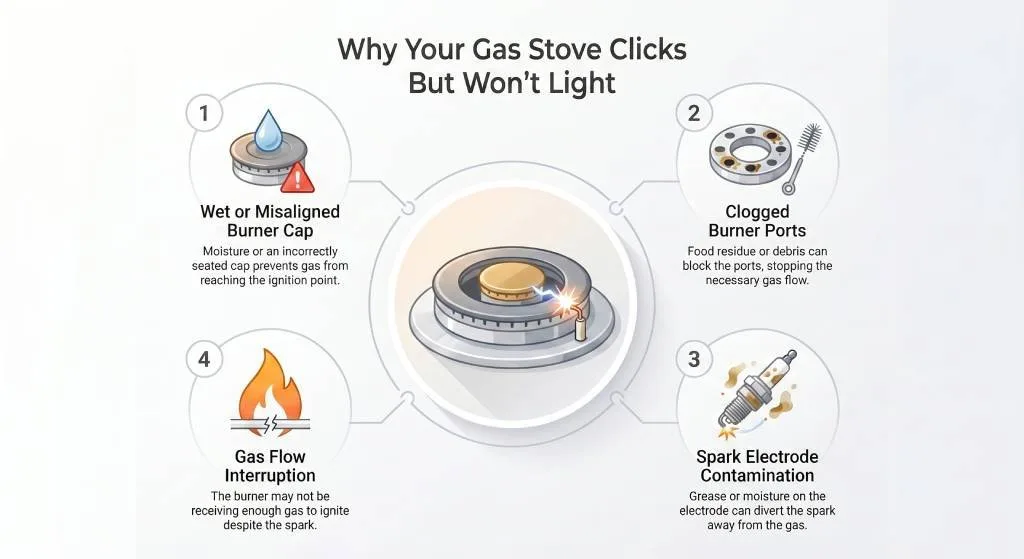
A clogged burner port or misaligned igniter is the most common reason a Gas Stove Won’t Light when the appliance has power. You can confirm this by listening for the igniter’s clicking; if you hear it but see no spark, the issue is likely physical debris. If you hear no clicking, the problem is usually electrical.
Why Your Gas Stove Won’t Light
| Cause | How common | How to confirm it | Fix it yourself? |
|---|---|---|---|
| Clogged burner ports | Very common | Visible food debris | Yes |
| Wet igniter | Common | Dampness after cleaning | Yes |
| Misaligned burner cap | Common | Cap wobbles or shifts | Yes |
| Faulty igniter switch | Occasional | No clicking sound | No |
| Blown fuse/breaker | Rare | Other kitchen power out | Yes |
| Gas supply valve off | Rare | No gas smell/flow | Yes |
| Defective gas valve | Very rare | Professional testing needed | No |
Safety: Inside a mains-powered machine, the parts behind the outer cover can hold a dangerous electrical charge even after it has been unplugged — that’s why they sit behind a cover. Opening the housing, or testing or replacing anything behind it, is a job for a qualified technician, never a home repair.
Debris blocking the burner ports
A burner port is a small hole where gas exits to meet the spark. When food spills or grease builds up, it creates a physical barrier that prevents the gas from reaching the igniter. You’ll notice this when the burner clicks repeatedly but refuses to produce a flame, or when the flame is yellow and weak. To confirm this, look closely at the holes around the burner head; if any are filled with black carbon or hardened food, they’re blocked.
To fix this, ensure the stove is off and the burner is cool. Use a stiff, non-metallic brush or a straightened paperclip to gently clear the holes. Don’t use a toothpick, as the wood can snap and leave a piece inside the port. After clearing the debris, wipe the area with a damp cloth and dry it thoroughly. If the burner still fails to light, the internal gas path might be obstructed, which requires a professional. This task usually takes about fifteen minutes. This isn’t for you if you’re uncomfortable removing the burner head or if the screws holding it down are rusted tight, as forcing them can damage the gas line.
Moisture on the igniter
Moisture is a frequent issue after you wipe down the stovetop with a damp cloth or sponge. The igniter relies on a clean, dry spark to ignite the gas; if water is present, the spark will ground itself out before it can reach the gas stream. You can tell if this is the cause because the stove will click consistently, but the flame never catches. If you recently cleaned the stove, moisture is almost certainly the culprit.
Wait for the burner to air dry for at least two hours before trying again. If you’re in a rush, use a hair dryer on a low, cool setting to blow air directly onto the igniter for three minutes. Don’t use a hot setting, as this can crack the ceramic insulation around the igniter. This varies by model — check the label for specific relighting instructions. If the burner still won’t light after it’s bone dry, the igniter itself may have failed. This is a common mistake people make: they assume the igniter is broken when it’s simply wet. It costs you nothing to wait, but forcing it can lead to a buildup of unburned gas, which is a safety risk.
Burner cap out of position
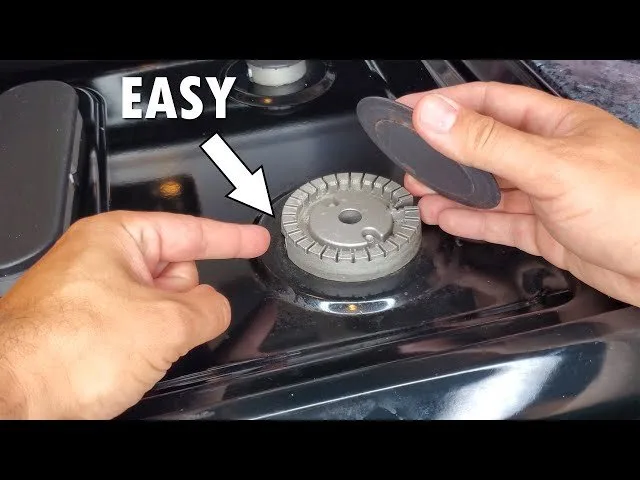
The burner cap is the metal disc that sits on top of the burner head. Its job is to distribute the gas flow evenly so the spark from the igniter can catch it. If the cap isn’t perfectly centered, the gas will flow in the wrong direction, bypassing the spark entirely. You’ll notice the cap wobbles when you touch it or looks tilted to one side. This often happens after you remove the caps for cleaning and replace them incorrectly.
To fix this, wait until the stove is completely cool to the touch. Lift the burner cap and inspect the alignment pins or grooves on the burner head. Set the cap back down, ensuring it sits flat and doesn’t move when you nudge it gently. This costs you only a few seconds of time. If your stove has multiple sizes of burners, ensure you haven’t swapped the caps; a cap from a large burner won’t fit a small burner correctly. This is a simple fix, but if you ignore the wobble, you risk incomplete combustion, which can lead to soot buildup on your pots and pans.
The less likely causes
-
Blown circuit breaker: If the entire stove has no power and the clock is blank, check your home’s main electrical panel for a tripped switch. A common mistake is assuming the breaker is fine because it looks centered; always flip it fully to “off” before snapping it back to “on.”
-
Gas shut-off valve: If the oven works but the stovetop does not, check the gas line behind the range to ensure the valve handle is parallel to the pipe. If the handle sits perpendicular to the pipe, the flow is blocked.
-
Faulty igniter switch: If you hear no clicking at all when you turn the knob, the internal switch has likely worn out. This requires a professional to replace.
-
Defective gas valve: If you smell gas but see no flame, stop immediately. Turn the gas off at the supply and call a professional. A persistent sulfur odor indicates a dangerous leak that requires urgent evacuation.
What a fix usually involves
Fixing a gas range typically involves either basic cleaning or replacing a small part. Most of the time, you only need a soft brush, a cloth, and a bit of patience to clear debris or dry out components. These fixes cost nothing but your time. If a part like an igniter or a burner cap is broken, you’ll need to buy a replacement from the manufacturer. The price of these parts varies, but they’re usually a small fraction of the cost of a new stove.
If the problem is internal, such as a faulty gas valve or a broken wiring harness, you must hire a professional technician. A technician will charge a service fee plus the cost of labor and parts. To get a real quote, look at the serial number on your stove and call the manufacturer’s authorized service center.
Frequently asked questions
Can I use a match to light my gas stove if the spark is broken?
Yes, you can safely light the burner with a long-reach lighter or a match. Turn the knob to the “lite” position, wait a few seconds for the gas to flow, and carefully bring the flame to the side of the burner head. Never leave the gas running for more than a few seconds without ignition, as this creates a dangerous buildup of gas in your kitchen.
Is it safe to keep using the stove if only one burner won’t light?
Yes, it’s generally safe to use the other burners, provided you don’t smell gas when the stove is off. If you smell gas, turn off the main gas supply valve immediately and keep the area ventilated. Don’t use any of the burners until a professional has inspected the range and confirmed that there are no leaks in the gas lines.
How long does it take for a wet igniter to dry out?
It usually takes about two hours for a wet igniter to dry if left to air dry in a well-ventilated kitchen. If your kitchen is humid, it may take longer. You can speed this up by using a hair dryer on a low, cool setting for three minutes. Don’t use high heat, as it can damage the delicate ceramic components.
Does it matter if I use a different brand of burner cap?
Yes, you must use the exact part designed for your specific model. Burner caps are engineered to work with the specific gas flow and igniter position of your stove. A cap from a different brand or even a different model won’t sit correctly, which will prevent the burner from lighting and could create an uneven or dangerous flame.
What happens if I smell gas while trying to light the stove?
If you smell gas, turn the knob to the “off” position immediately and open nearby windows to ventilate the room. Don’t try to light the burner again. Leave the area and call your gas provider or a professional technician from a safe location. A persistent smell of gas indicates a leak that requires an expert to repair safely.
Is it hard to replace a broken igniter myself?
No, it isn’t technically difficult, but it’s a repair that requires specific safety knowledge to avoid gas leaks or electrical shorts. Most manufacturers recommend that you hire a professional for this task. If you choose to do it yourself, you must be able to disconnect the gas and power safely, and ensure the new part is installed without any gaps.
Final Thoughts
If you’ve tried these fixes and the burner still won’t cooperate, it’s time to call a professional. Don’t keep fiddling with the gas lines if you’re unsure, as it’s better to stay safe. A technician can quickly identify hidden wiring faults so you’ll be back to cooking your favorite meals soon.